Thursday, February 1, 2007
Cow vs Van
Wednesday, January 24, 2007
Flooding at Tissamaharama
A bus negotiates the flood-waters:
A three-wheel tries its luck:
Our turn:
Flood waters threaten Kataragama:
Returning to Tissa from Kataragama:
Friday, January 19, 2007
Buddhism and Violence
One poor creature near the Tissa stupa:

Ronnie rescuing a dying pup:

Dying pup eating buffalo curd:

They say that the monks reportedly threatened them to leave the island. Around 8-10 Buddhist monks from JHU with 70-80 supporters rushed into the premises, took the attendance registers and some keys and photographed everybody, said a ZOA official.(www.colombopage.com/archive_07/January12140400SL.html)
Tuesday, January 2, 2007
Perehera at Keleniya

This is the lead elephant of the perehera. It would probably be a very old and venerable creature that has been designated the task of being the perehera elephant for many years. In this particular perehera, the elephant does not carry a dhatu or religious artifact, but in the esala perehera which happens in may, the elephant carries the holy tooth relic mentioned below. This particular elephant went for a huge crap and wee (it looked like someone was hosing down the path, but you wouldn't want to step in it). He also inhaled a 'snack' of an entire hand of bananas as we might eat a single lolly.

The procession was a distinctively Singhala affair - since it is primarilly Buddhist - and only provided images and costumes associated with Singhala legend. Consequently, there were several groups of flag bearers that bore the image of the Sri Lankan flag. The Singhalese are quite natioanlistic, so this is not particularly odd. See previoius posts for an analysis of the meaning behind the flag.

According to Sri lankan legend, the Singhala people were a product of the copulation between a god and a lion. The lion (singhaya) is therefore an important animal in within the Singhala psychological scehma. As far as I know, however, lions are not native to Sri Lanka and I don't believe that any actually live there, so the origins of the myth remain a mystery to me. In any case, a lot of Sri Lankan art involves images and designs of lions and they are common guardian figures at important Buddhist sites.

Perhaps the most popular god worshipped by the Singhalese is Katuragama (a town is also named after him. Katuragama is the Hindu war god Skandha and he has risen in importance over the last fifty years to replace the official guardian of Sri Lanka, Vishnu. Katuragama's vehicle is always the peacock - another important Sri Lankan animal (it features on 1000 rupee notes) along with the snake. These dancers above are therefore implying Katuragama, although having an image of Katuragama in a Buddhist parade might be religiously confusing for the onlookers.

Another important god in Sri Lankan lengend is Hanuman, the monkey god. He is generally regarded as mischievious individual and his moral worth in the eyes of Sri Lankans is unclear to me (for example, Katuragama is regarded as morally impure, but he is nonetheless highly respected). The story is that Hanuman fled India with a kidnapped bride and escaped to Sri Lanka. He managed this by jumping across the strait with his powerful legs arriving in what is now known as Bandarawella. There he kept the bride imprisoned for many years causing grief to the ruler in India. The story is told the same way in India.

These people are all stilt-walkers. As far as I can tell, there are no distinctive cultural implications involved with this - its just a bit of fun. However, it looked rather uncomfortable even though the people were having a lot of fun!
Saturday, December 30, 2006
Pilgrimage


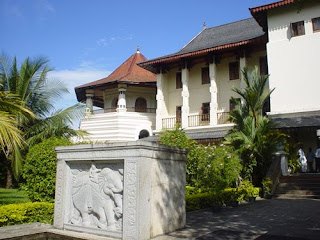
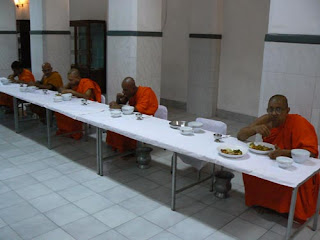
The dane ceremony basically amounted to the principle monk (the fellow third from the left) giving bane (i.e. preaching). In this instance he talked - amongst other things - about the importance of marriage and blessed both of us! The monks at the Dalida Maligawa are a funny breed of monk in that they are generally quite learned and pious - in this sense they are usually quite a bit more serious looking than other monks (and this saying a lot since the main purpose of being a monk is to precisely to be serious). After the monk fishes preaching, the pilgrims go about giving out the food that had been prepared the night before. This involved us going around and spooning food into the monks bowls. In this instance, the monks seemed quite pious since few of them would take any kind of meat.
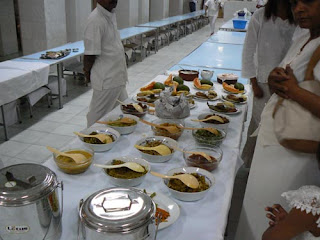
Some of the food we provided:

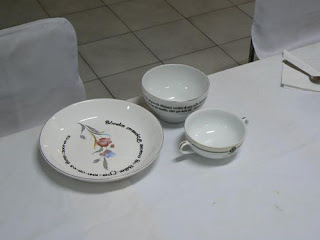
An example of the monks bowls and cutlery - notice that they are all quite plain (again part of the ascetic ideal), except for the writing (which simply states who the donor of the cutlery was therefore guarenteing that they get the appropriate merit - and social recognition. Many material gifts for monks have the name of the donor written on them. It is part of the technological mechanics of merit aquisition). Also note that the chairs upon which the monks sit is quite low (i.e. the legs are short): this is all part of the complicated monastic code which is designed to help the monks reduce desires.

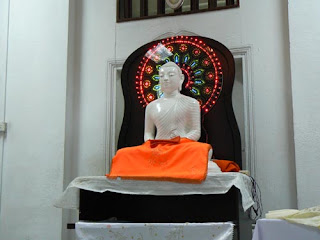
Here is the Buddha statue in the monks eating quarters. This statue also receives alms prior to the dane. One interesting innovation which might represent a modern Hinduistic influence is the use of bright strobe lights behind Buddha statues. They usually represent the lights emitted from the Buddha when he attained enlightenment (although the colours are hardly comprehensive). I say it might be a Hindu influence only because such opulance is quite un-Buddhist like. But Sri Lankans are very competitive and would hate the idea that a Hindu deity lhas more bling than their own Buddha statues!

Going to all the trouble of visiting the hill country, seeing the golden tooth, preparing a veritable banquet of food and attending to the monks at the Dalida Maligawa all involves a huge amount of merit aquisition. Many families - including Kumudu's - do this once a year so that the merit they reap will guarentee a good future (although any belief that they will benefit before they die would be misplaced, and I happen to think that people believe this rather un-Buddhistic notion). One other thing about the tooth relic: although it is enclosed in the ritual casket described above, the tooth itself has gone on display at various times. Reputably, it is extremely large and looks rather like a yak tooth - but one shouldn't let that get in the way of a good mythological ideal!
*Although it is called Kandy, the proper Singhalese name is Nuwara. "Nuwara" simply means 'Town', so in a way it implies simply 'the town'. This probably is a throwback to when Kandy was the capital of the high country, prior to when the English captured it. That is, it really was the only big town that locals could go to hence it being simply called 'the town'. The name 'Kandy' is an English invention based upon the Singhala for hill 'kandha'. Nuwara was too complicated to say, and saying kandha with its unstressed '-dha' sound was also too difficult, so Kandy was invented, i.e. to denote that the city is in the heart of the hill country.
Thursday, December 28, 2006
Boxing Day - Then and Now

Moratuwa 2004 - What was left of peoples homes:

Moratuwa, 2004 - "Close" , Understatement of the year:

We kept well away from the coasts, not wishing to get in the way of the sudden influx of aid that had arrived, not to mention our desire to avoid infection: the coastal areas were rife with disease. When we visited Yala a few weeks after Boxing day, the air was sick with disease and we couldn't even leave the vehicle we were driving in. Regretably, I saw people bathing in clearly infected water: In other words, it was completely yellow and putrid.
Yala 2004, the water as it was then:


Wednesday, December 27, 2006
Foreigners in Sri Lanka

(Sri Lanka's Flag: The lion is a Singhalese national symbol, the leaves at the four corners are Bo leaves and represent Buddhism, the maroon colour is a Singhalese colour, while the green and biege represents the Tamils and Moors - Muslims - respectively).

Later, the Portuguese colonized the coast of Sri Lanka starting in 1505, essentially dominating the island economically. Subsequent to this, the Dutch invaded and wrestled control of the island from the Portuguese during the 1700’s. Finally, the English declared Sri Lanka a crown colony in 1802 and developed much of the infrastructure currently in use today. It was also the English that managed to control the inland, defeating the Kandyan Kingdom and defeating the Sinhala army that had for so long maintained control. The lengthy colonization of the Sri Lankan coast has resulted in a more cosmopolitan feel and outlook in coastal areas, and a more rural and simple way of life inland. Nonetheless, most Sinhalese look to the high country for cultural inspiration since it remains somewhat unchanged since English dominion.

In spite of this colonialism, the Sri Lankan people still retain a unique culture and society, in many ways no different from the practices of their ancestors. In spite of the violent history the settlers brought, the Sri Lankan people seem to harbour no ill sentiment towards foreigners. The Sinhalese generally regard white people (sudhas) very warmly as if they represent a high point in Sri Lankan history. Nonetheless, they are often amused by the peculiar antics of tourists sometimes secretly calling them pissu-suddha “crazy white people”. This is always said in a very light-hearted way of course, but the term is – when one thinks about it – quite astute. This is often because suddhas become thakkali-suddha “tomato suddha” on account that they go directly from the airport to beaches – usually Bentota on the west coast – and become ragingly sunburnt (an impossibility for the locals). There are other reasons why suddhas might be classified as odd: they tool around in floral pattern shorts with ridiculous hats and take pictures of stray dogs (guilty! – I’ll show my collection of stray dogs later).