Friday, March 23, 2007

India: Chennai - Nalanda

Our first stop in India was Chennai. As if in anticipation, Kumudu instantly gets a bought of Delhi Belly. We are both surprised since we both thought I would be the one to suffer such a fate. This prophecy is later confirmed: over and over again...
Chennai was everything we expected: dirty and noisy. The drama of being stared at by locals starts as soon as we step on the plane from Colombo. However, it's not me they are looking at, but rather Kumudu. Apparently she is quite the celebrity in India. We suspect that the possibility of an 'Indian' being married to a white man so perplexes the locals and offends the sacred Vedas so much that they cannot look away. She is constantly and repeatedly asked whether she is an Indian, whether she speaks Hindi/Tamil/Bengali/Urdu etc. Revealing that, no, she is actually from Sri Lanka, is immaterial. Sri Lanka, it seems, is regarded as some obscure, little heard of province, in which the inhabitants speak some Indian dialect out-of-state, i.e. Hindi/Bengali/Tamil/Urdu etc. At one point I tell a vagrant who has accosted us, and is demanding to know where K is from, that she is actually South Korean and her name is Soon-Yi, and that - yes - all South Koreans look remarkably like Indians. Eventually we both go mad and pretend we are German tourists who don't even speak English.
We visit various sites in Chennai, including Marina Beach. An enormous beach that was devastated by the 2004 Tsunami (see picture). It is the highlight of our trip to Chennai. At a large Hindu kovil (temple) my shoes get filched by some reprobate. A true Indian welcome! (See picture below for image of missing shoes).
At Marina Beach, Chennai:

Next stop - Kolcatta (formerly Calcutta). Arrive at Chennai airport to discover two-bit flight has been cancelled. Immediately board another two-bit flight which has us arrive in Kolcatta late and tired. The Lonely Planet describes the CKT Inn as a real find that is 'tucked away in an office building'. Tucked away = concealed behind a dirty, homeless-person infested alley. Nonetheless, we soon come to realize that there is no such thing as a completely reputable place of abode in Kolcatta, nor India for that mater. K and I aim for 'mid range' venues with the notion that they would be: a) comfortable, but b) not to expensive. We find, however, that there is a very wide gap between 'budget' and 'mid-range' and you can neer guarentee that any of the places we lodge in will be anything resembling comfortable. We are satisfied, however, when we hear from other travelers that 'budget' is suitably horrific and that we are actually in a fairly pleasent little hole.
At the Victoria Memorial, Kolkatta:
A street near our hotel, Kolkatta:
Kolcatta is an old looking city, plied with yellow taxies and endless beggers. We have a great time exploring the dingy back streets, and the various cultural institutions. We skip Mother Theresa's house and head straight for the Victoria Memorial, the Kalighat and the Botanical Gardens. On our second day, as we head to our regular breakfast venue (called 'Flurry's), we are quickly accosted by a small leech-like begger boy whose desire to rob us of our money borders on assault. Demanding that we 'give him 10 rupee' he practically attacks us, touching our limbs and pushing us around the street! We manage to escape his clutches by escaping down a side alley while he is distracted. Later we visit the Asiatic Society. An interesting place for me since they have plenty of old Sanskrit texts, but the caretakers are plainly annoyed at the presence of any interlopers and give us plenty of evil looks as we potter around the dusty shelves. We also have to sign an implausible number of 'guest books' plainly designed to infuriate the guests such that they neer return and also tell their friends ot to visit. A brilliant plan!
Kumudu and I returning from Kalighat:
Kalighat, Kolkatta:
The best place in Kolkatta was the Kalighat - a temple dedicated to Kali. Kali is the goddess of blood and violence, and goats, buffaloes and chickens are routinely slaughtered at the temple in her honour. Kali is the savage aspect of Pavati, the consort of Shiva. She also represents his shakti or 'power' in Tantric hinduism. This explains why Kali becomes more popular the further north one gets - i.e. closer to the Nepal, the Himalayas and the Tantric schools. The temple is an interesting place, and we are assaulted by a myriad of guides one of whom we grudgingly pay for a tour (the problem with guides are: a) they always try and rip you off and b) you never know if they have any idea what they are talking about). In any case, we end up with a tikka each (or bindi in Singhala) which is meant to be both a ward and a blessing, a symbol of the ubiquitous 'third-eye'.
After we finish at Kolkatta, Kumudu and I arrange for a train to take us to the remote town of Gaya in the middle of the somewhat lawless state of Bihar. Regretably, many of the Buddhist sites we intend to visit are located in the middle of one of the most lawless states in India! Another Indian contradiction?
We arrange for a first class ticket to Gaya, naively thinking we would get a private cabin. Instead we have the privilege of hanging out with two Indian businessman and eating some train food of questionable merit. We arrive at Gaya in the dead of night, are knocked over by how freezing it is, and quickly requisition an all-terrain three-wheel that quickly drops us at our hotel - Vishnu International. The Vishnu International is a nice little place, i.e. clean, but has no hot water and a generator that wails all night long. A funny story about hot water: Whatever place we stay at, no matter what the staff may say, the hot water never ever works the way they say it will. The upshot of this is that the staff will insist that it works and spend a good 20 or 30 minutes hanging out in your bathroom turning the water on and off, before finally declaring 'No hot water!'. Our protests that they should simply bring us a bucket go unheard. This is the case for all the hotels we stayed at.
The following day we visit Bodhgaya - a half hour three wheel ride from Gaya. On the way we spot three dead dogs and several starving ones. It is also one of the filthiest towns we have seen, trash piled high everywhere. The place is quite remote and the locals seem disturbed at the prescence of outsiders. Nonetheless, the people are friendly and the townsfolk at Bodhgaya are more used to visitors. Bodhgaya is the site at which Buddha attained enlightenment. The Bo tree that the Buddha sat under is no longer there (destroyed by Queen Ashoka), but a replacement from the holy Mahabodhi in Sri Lanka now stands in its place. We witness several sudhas worship in the Tibetan style (which amuses me greatly) and walk around the beautiful grounds. Its funny that while everywhere else in India is grubby, the Buddhists at least manage to keep their sacred places clean.
The Mahabodhi Temple, Bodhgaya:


Goats eating a sari at Bodhgaya:


Once we finish at Bodhgaya we arrange for a car to take us out to the even more remote spot of Nalanda and Rajgir. The car arrangements are a fiasco in which we try to employ the aid of a local agency, only to discover they have no idea what they are doing. And in any case, the organizer has the manner of a serial killer so we quickly back out. Instead, Vishnu International supplies a vehicle. The cost is exhorbitant, and the driver incompetant, but it is much preferable to taking a dodgy local bus for two hours (we discover how right we were later when we are forced to take a local bus in Nepal - more on that later). As we leave Gaya destined for Rajgir, the driver stops to let in another passanger. Low and behold its the same fellow who attemped to organize our aborted plan the previous day! He's a sly looking fellow who insists that it is 'his car' and 'his driver needs someone to come back with'. We tell him to bugger off and leave him by the side of the road.
Rajgir is a barren piece of land in the middle of Bihar that is composed of a great deal of dry schist like land, and several messa-like hills that rise up in the distance. On one of these hills the Buddha preached several of his sermons including the important Brahma-gala Sutta. In order to get up the hill one takes a highly suspicious gondala that would be an OSH law-suit in the making in NZ. At the top is a marvelous stupa - A World Peace Pagoda (there are several such stupas around the world, all developed by the Japanese as part of their anti-nukes initiative). There was also a beautiful Tibetan temple. The whole place was very quite and quite serene. Another interesting feature of the area was the use of tongas - a tonga is a horse drawn cart which is used to ferry people around from here to there in a fairly cheap way. We had a great time clopping around the streets in these things, especially given how spread out the whole area was.
The next day we travelled to Nalanda. This required us to take a local bus for about 6 km. It was an interesting experience that involved several hair raising encounters with local traffic and lifestock. Once there, we took another tonga to the Nalanda ruins and had a great time looking amongst them. Nalanda is especially important to me since it is the site of the great Buddhist University where many of the most famous Buddhist philosophers were to live. Nagarjuna was, in fact, the director of the university for a time. Dharmakirti, Dignaga, Vasubandhu were all students there for a time. We had another guide at Nalanda who was very informative. Unfortunately, the place was populated by the most enormous wasps ever conceived: they were huge and yellow with a huge barb, and these long dangly legs. They completely freaked me out and whenever I saw one I gave it a very long berth.
It was also here that we bumped into Nick. We already met Nick at Bodhgaya while we had lunch. He introduced himself and sat down with us; he was an American who was right into his martial arts and Buddhism. He claimed he was in Mumbai teaching the Police force ninjitsu or some such rubbish. In any case, we bumped into him again at Rajgir AND Nalanda. He was an interesting character, but not someone I'd wish to spontaneously encounter three times. He was completely self absorbed and regarded himself as some kind of guru.
Kumudu at Nalanda ruins:
Me at the famous Nalanda ruins (the large structure is the remains of a stups):
Finally, the claim that Bihar is a lawless state was somewhat confirmed when we tried to leave Rajgir with the same driver a few days after we arrived. As we went to leave, he failed to stop at a tollbooth - on purpose obviously. The next thing we know, an overweight man is running after the car, screaming something in Hindi. Soon, the driver is being soundly beaten about the face by the man, causing him to look humiliated and angry. Obviously we are both scared witless, and the encounter is made more disconcerting by the crowd of children and adults that quickly flock around the car. Luckilly, the driver pays his due and we are soon on our way, but we are left with the distinct notion that vigilante justice reins supreme in Bihar.

Monday, February 12, 2007

Galle and Unuwatene

Galle is an unusual Sri Lankan city in that it is very relaxing and laid-back. Galle is Sri Lanka's fourth largest city, and was historically a major trading port. The fort area, built by the Dutch, is a UNESCO world heritage site and extremely beautiful. The fort itself is like a different world - very relaxed in comparison to the rest of Sri Lanka (especially Colombo). The fort area is populated by various craft shops, some tacky museums, but mostly exquisite Colonial architecture. Most of the hotels in Galle seem to be owned by sudhas and many of the shops are as well. One craft shop we went to was owned by a French women who was married to a local. Their child was striking to say the least. The 'Galle Fort Hotel', probably the most upmarket and swanky in Galle, was owned by an Australian. We went to their resteraunt for dinner (expensive, but luxurious), and Kumudu was confused by him as someone called 'Sally' and greeted her as an old friend! He also owned two purebred dogs that entertained dinner guests and yapped vigourously.
Kumudu and I stayed at the 'Sun House' on Upper Dickson Road. The hotel is a renovated spice merchant house, built in the mid 1800's. Consequently, it was quite special and was secluded away from the rest of Galle. It was a highly authentic, relaxing and atmospheric place, that had a lounge so that we could mingle with other guests (there were only 6 rooms in total). We chatted with an older couple who had come from England. He was a retired textile lecturer, cum lay clergyman, cum justice of the peace, who was dyslexic (all this in one short conversation). His wife was quite absent from the conversation. Needless to say, a strange couple.


'Sun House' room and Kumudu:


The 'Sun House' exterior:


The 'Sun House' pool and garden:


The fort area is a large medieval-like fortification jutting out into the water. We took a stroll along the wall which was quite relaxing. Regretably, there were an implausible number of touts, fixers and low-lifes hanging around ready to acost hapless tourists. Even more problematicaly, they were even more persistant than your average tout and simply wouldn't go away unless they given a stern talking to. Some boys were asking tourists to pay them so they could watch them jump into the water far below the ramparts (which they duly did regardless of payment). Nonetheless, the whole place was picturesque.


Lightouse in the Galle fort area:


Image of the Galle fortifications:

A typical street in the fort area:

We also visited a beach only 4 kilometres away called Unawatene. Unawatene is probably the nicest beach I've been to in Sri Lanka, it has that Bahamas-esque quality to it: short beach, deep transparent water, coral reef, etc. The food was also amazing and the town itself was quite off the beaten track so it wasn't overcrowded. The coral, regretably, is dying, and this is evidenced by the copious amounts of broken coral washing up on shore. The reason, as always, is entirely human in origin.


Unawatene beach:


Kumudu and I at seaside resteraunt:


Unawatene beach:


The whole trip was great fun. However, our driver 'Bertie' was an interesting case. We paid him to take us to Galle and back over two days - he was good for 300 km (basically Galle and back plus extra driving around). When we arrived at the Sun House, however, he discovered that there was no room where he could stay. This later turned out to be a problem since he asked us to pay for his room. It wasn't much, but one is always left wondering: is this legitimate or am I being played by this guy? It is certainly out of the ordinary for drivers to bother their employers about living arrangements (usually they just sleep in their van if a guesthouse doesn't provide a room), so the whole thing was suspcious. In the end, we just paid him the money - rather grudgingly - but mainly because it was easier.

Saturday, February 10, 2007

Seenigama Temple

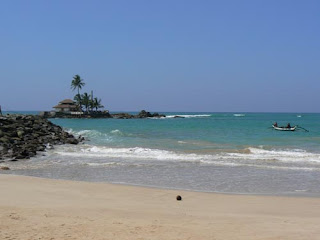
On our way back from a small trip to Galle we stopped at the Seenigama temple in Hikkaduwa. Hikkaduwa is a major surfer hangout and a popular spot for tourists. But one more interesting (and sinister) aspect to the town is the offshore temple pictured below:


The temple is located about two hundred metres offshore and can only be got to by boat. It is perched on a small island - the water around it is relatively shallow. We paid Rp 350 (300 = foreigner, 50 = Kumudu) to get a ride out to the island - I think the boat ride was the best part actually.


This is a picture I took while I was on the boat. I was worried that I might drop the camera in the water because the boat was so narrow and the water was quite choppy. However, after some careful handling I managed to take this hurried picture. The boat, I think, is a fishing boat, but might be dedicated just to ferrying people and supplies between the mainland and the island - I'm not really sure.
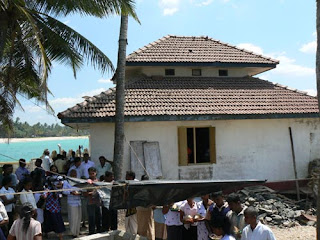
This is the temple in question. It is built in the typical Sri Lankan style and is a kovil or Hindu Temple. It is dedicated to - get this - Dewol deviyo (the god - with a small 'g' mind - called Dewol) who is a malicious and malevolent deity that one worships if revenge is required! All the people crowded on the small island (see below) are dedicated to this task:

First, the people will enter the structure above where there is an image of the Dewol deviyo. Clasping small bowls of garlic, chilli and other acrid and pungent spices, a small puja takes place presided over by a priest (compare these gifts with other Hindu temples - usually sweet fruits like mango, pineapple, etc are given, but here 'angry' spices are supplied - clearly the malevolent deity only feeds upon these pungent substances).

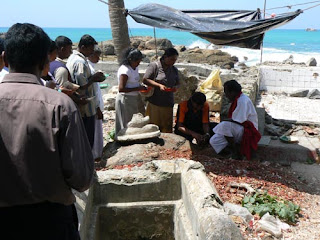
Next, they take the offering outside where everyone lines up (it is the only place in Sri lanka I have seen where people actually queue properly!) so they can take their turn with the priest. Kumudu reported that the priest asked what their problem was, the people then proceed to tell the priest how they were wronged. After that, the offering is crushed with a pestle (representing the deity feeding on the gift I take it, and the rock itself being the very maw of the deity).

During all of this the priest chants incantations asking that 'justice' (or revenge - depending on whether a genuine wrong has been carried out) be done and the transgressor punished. The general idea is that either: a) something very bad will happen to the person who did wrong, or b) they will be revealed as the culprit if the wrong doer is not already known. I suspect, however, that many people go to the temple simply to try and precipitate some cosmic punishment on people they dislike! Below is the remains of the offering after it is crushed. There is a very pungent smell that hangs in the air on account of these ground spices.

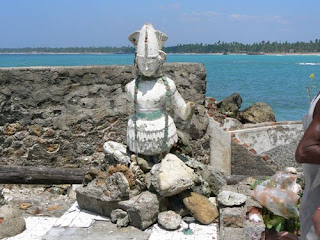
Finally, I discovered this curious statue located near the temple (it was quite a cramped area mind you, being that it was an island and there were quite a few people already on it). I could not figure out who the image is of, but I suspect that it is actually some detrius discovered on the island after the tsunami that had been made into a makeshift shrine. As it turns out, the temple itself miraculously suffered no damage after the tsunami! This was taken to be highly auspicious, and proof that the deity is both very powerful and very real. On the whole, I found the whole place very powerful and beautiful.

Thursday, February 1, 2007

Cow vs Van

They say the traffic in Asia is crazy, and this probably has something to do with the variety of traffic hazards that one has to negotiate. One such hazard is the humble cow. These creatures happilly wander across the road at their leisure, and usually make a home for themselves on traffic islands and road verges. I'm pretty certain that they are purposefully released by the Colombo council as a cheap way of maintaining the public lawns and keeping grass by the roads at bay.
Recently, we had a close encounter with one of these poor creatures. We were driving back from Kegalle (in between Colombo and Kandy) and we had got to a town on the outskirts of Colombo called Malebe (I always make a joke about the town because it seems to go on forever - it seems an especially long time in the awful Colombo traffic. It has to be the longest suburb in Colombo). Suddenly, Kumudu's Dad slammed on the brakes. We looked up, and in this terrible moment we saw a cow obstructing the road. It was horrifying instant because we realized that there was no way we could stop in time - it was a moment where we realized something would happen, but it wasn't clear what the outcome would be.
Luckilly, Kumudu's Dad had put the brakes on at the right moment because - although we collided with the bovine - we didn't really crash into it. So I suppose we can define it as a run-of-the-mill traffic accident rather than a bonafide crash. There was this thud, and the cow was swept up the front of the van for a moment before being thrown forward. The cow looked shocked for a moment, and then promptly wandered off quite happilly. We quickly beat it, as we knew that the farmer would be pissed and Sri Lanka is the kind of country where the term 'vigilante justice' gets its origins (joking).
Meanwhile, the van seemed to come worse off. the front of it had a huge dent in it, the right lamp was fully broken off, and the fender was dented. Moreover, the windscreen had spider-webbed (this was to grow in the coming days, heh - why get it repaired when we were renting it?). I can safetly say that the vehicle owner was furious. And in spite of the fact that it was 'insured', Kumudu's Dad still had to pay LKR 50,000 (about NZD 500-600). This was mainly because the guy was some kind of dodgy character that shouldn't be crossed (we got the van dirt cheap anyway).
Oh, and the accident wasn't our fault since the cow wandered onto the road from the wrong side (its a miracle the traffic on the other side avoided it). The thing that cracked me up most was how the van was damaged, but not the cow! As I say (rather un-idiomaticaly) me: van-ekak kadila, habe harack kadila-nehe (the van is broken, but the cows not).

Wednesday, January 24, 2007

Flooding at Tissamaharama

Talk about history repeating itself. In 2004 I arrived in Sri Lanka worried about terrorism, but instead was threatened by a tsunami. Again, in 2006 I came concerned about my families reaction to the civil war, but instead got trapped by flood waters! It's almost like the country is asserting itself to remind me what the greater danger is.
In any case, our travel around the island was rudely compromised by the gradual introduction of rain. We thought nothing of it until we arrived in Nuwara Eliya, the town with the highest elevation in Sri Lanka. Nuwara Eliya is known for its beautiful tea plantations and its lousy weather. In our case, we got the lousy weather, but no landscape. It was freezing cold - something I had not even considered in Sri Lanka which seems to have perpetually balmy weather - and was raining endlessly. We should have guessed something was amiss when we observed the landslides partly obstructing the road leading to Nuwara Eliya. However, in true Sri Lankan style our driver 'Longtooth' (on account of his implausibly long canine) evaded the slides with great skill, and so we thought nothing of it.
Oh, and for future referance if anyone visits Nuwara Eliya, they should most definately not stay at the 'Hellenic Inn' which can only be described as a flea pit, with no amneties and the most incompetant Faulty-Towers-esque staff ever conceived. The Lonely Planet, inexplicably, describes it as "comfortable" and "modern". It is, however, true that it has an "excellent view:, although in our case we only 'viewed' a thick mist sitting a foot away from the window. The blankets were ancient things, the covers dusty and allergy-inducing and the mattress' not dissimilar to sleeping on the street. The showers must have been water-blaster rejects since the pressure was so high one could not stand there for anymore than a few minutes- and it was icy cold. Finally, the food they served was poisonous - who puts chilli in vegetable soup?
In any cae we fled Nuwara Eliya and eventually found ourselves in Tissamaharama in the low lands. We thought (wrongly) that the rain was peculiar to the high country. Instead, we discovered that - in our eagerness to break out of Nuwara Eliya - we had nearly got ourselves trapped by flood waters.
Despite this, we booked ourselves into our hotel in Tissa. Unfortunately, our trip to Katuragamma (a Sri Lankan pilgrimage site) seemed to be ruined because the river waters had flooded the only bridge into the town. We weren't the only people delayed by this development. As we prepared to investigate the bridge, a convoy of vehicles screamed into the hotel courtyard and armed men burst out of them, AK-47's at the ready, forming a security barrier. Out stepped a Sri Lankan MP who calmy booked himself into the hotel. So not only were we threatened by rising flood waters, we were also housed right next to a prospective terrorist target!

A bus negotiates the flood-waters:


A three-wheel tries its luck:

Our turn:

Flood waters threaten Kataragama:


Returning to Tissa from Kataragama:

The fact that the bridge was out of order certainly did not deter the locals. In true Sri Lankan style they were fording the waters anyway: three-wheelers, buses and cars were all making their way slowly across the bridge, in many cases only barely. We even saw an old man carefully making his way across: a cane and a scrawny child his only means of support. So, rather than give up - as would be the normal, rational procedure - we adopted the local custom. We donned our already soaked 'waterproof' clothing (bought hurriedly from a dirty little shop in Badulla). Then 'Longtooth' called a mysterious friend who arrived with an all-terrain-vehicle (meant, I think, for safari's at Yala) and helpfully drove us through the rising waters.
The Katuragama temple was loud (Hindu's often worship through sound), but probably wasn't as interesting or as fun as how we got there. In the driving rain we completed the Hindu ritual by hurling a burning cocout into a cage thereby conferring bad luck (mine didn't break - I take it this implies indifference on the part of the deity). We got a fright when there was a brief power cut leaving us in pitch blackness in a near emergency zone. In any case, we must have done something right because Katargama (the god the town is named after and also the guardian of the region) allowed us to leave safetly, and the next day we made it past the flooded waters along the only road that was open, all the way back past the road that took us to Nuwara Eliya.
It seems like natural disasters follow me wherever I go! At least this one was less dangerous and tragic than the tsunami (although at times I wondered what the state of the Sri Lankan rescue service was like. Ultimately, it was somewhat more exciting too and even though we didn't get to visit Yala National Park, or Horton's Plains we made up for it with a rather peculiar aquatic adventure.

Friday, January 19, 2007

Buddhism and Violence

Within all religious traditions, there is always an inconsistency between the ethical demands of the teaching and the practical implementation of those teachings. This is is most obvious in theistic traditions, but is also clear even in Buddhism. The failure even of Buddhists to follow their own moral parameters has occasionally been highlighted to me since I arrived in Sri Lanka. One prime example of this was when we visited the famous Tissamaharama Stupa - perhaps the oldest stupa in Sri Lanka (so old, the clay is bound together with honey).
A common sight in Sri Lanka - as with most developing countries in Asia - is the presence of a huge number of malnourished, scrawny and mangy dogs. These flea-bags roam the streets of Colombo day and night looking for trash (provided in plentiful supply) to nibble on. They often move in packs and universally look depressed and dying. They are, of course, a pest and cause all sorts of problems for locals. Consequently they are often shooed away whenever they happen to wander onto private property. However, at the Tissamaharama Stupa, we found one particular stupa- attendent savagely whacking a dog with a piece of wood busy driving it from the vicinity. This seems odd, since ostensibly a religious site is meant to be a place of peace and harmony. In Buddhism, it is a venue that is intended to be peaceful and an ideal of serenity and non-suffering. So it seems quite inconsistent to be beating animals in a pansala (temple) and especially at the venerable Tissa Stupa.

One poor creature near the Tissa stupa:


Ronnie rescuing a dying pup:


Dying pup eating buffalo curd:

Assaulting helpless animals might not stir one's moral convictions of course, so let us instead consider the practice of alms giving. Within the ordinary, modern Buddhist schema, one should treat monks with the utmost veneration. They are the symbol of learning and represent a striving towards moral perfection. They should, it will be argued, be respected on account that they have given up their life of comfort for a simpler - in fact, ascetic - existence that is highly rigorous and difficult. If any of these qualities were true, then I would agree that monks should be respected and highly regarded. However, like any other monastic tradition these qualities are often - perhaps usually - not demonstrated. One should not assume - as many Buddhists do - that monks should be prima facie respected since they do not know if they are really any good at being monks. This notion is cognitively non-sensical to most Buddhists, but I happen to believe that any layperson who takes Buddhism seriously should be very careful about what monk he or she respects and venerates. This is because failure to do so is precisely un-Buddhist. Doctrinely, the Buddha claims that monks who fail to follow the Viniya (monastic code) in a strict way should be rejected from the Sangha (monk body). Furthermore, he suggests that a person - in general - should be rated only on their moral worth, not on birth and not on social status. The monk is meant to be respected because he is moral. So surely, if he fails to be moral then he is not really a monk and therefore should not be venerated. Philosophically, this is conducive with the empirical nature of Buddhism, i.e. that one should only believe what is justified through the senses. So if one cannot be certain of a monks rectitude, one should not worship or venerate him. This, it woudl seem is entirely Buddhist.
A fine example of this is a case I encountered when I was providing a course on Buddhist philosophy at the University of Auckland last year. Two Taiwainese nuns attended initially with great interest. It soon became clear, however, that they were the worst students in the class. First, they only showed up for two classes and second, they talked throughout. Clearly, based upon their conduct they could not be venerated nor regarded as virtuous Buddhists.
One other obvious un-Buddhist practice in Sri Lanka are the numerous politically active monks who promote violence against Tamils and often participate directly in violence against Tamils, NGO's and other parties. Consider this article from the "Colombo Pages"
Jan 12, Colombo: ZOA Refugee Care, a Dutch Christian aid group said that their office was stormed today by hardliner Buddhist monks belonged to the Jathika Hela Urumaya (JHU) party. The NGO is under suspicion by Sri Lanka military for providing assistance to the Tamil rebels in the Eastern Province of Sri Lanka.
They say that the monks reportedly threatened them to leave the island. Around 8-10 Buddhist monks from JHU with 70-80 supporters rushed into the premises, took the attendance registers and some keys and photographed everybody, said a ZOA official.
(www.colombopage.com/archive_07/January12140400SL.html)
(NB - note that the manner that this article is written is not necesarilly objective since all media is essentially government operated or monitored. For example, the aid group might be regarded as "pro-Tamil" in the sense that they are aware that a huge number of refugees are Tamil, but not "pro-LTTE". Helping Tamils and helping the LTTE are purposefully conflated in this sense. There is nothing new in this kind of state-run reporting of course. Also consider early CNN and Fox coverage of the current Gulf conflict).
Obviously these activities are thoroughly un-Buddhist, and monk political parties have had a history of promoting violence against Tamils and seem to have a great deal to do with domestic policy in Sri Lanka specifically around the so-called "problem up north". One would assume that if monks and Buddhists were to promote anything it would be Ghandian non-violence and not nationalistic, racist propaganda. In this sense, the first thing they would do would be to want peace and harmony. They should do their utmost to discourage violence and, in fact, condemn it since it results in the greatest sin in Buddhism: the generation of suffering. In this sense, these monks - again - can only be regarded as non-monks and as particularly sinful Buddhists.

Tuesday, January 2, 2007

Perehera at Keleniya

On New Years day we went to a rather large and important Buddhist temple called the Keliniya Mahavihara (Great Temple of Keliniya). According to the Singhalese account of Buddhism, the Buddha visited this area - as well as two or three other places in Sri Lanka (depending on who is telling the story). We were rather lucky on that particular day because we were able to see a perehera or religious parade. A perehera is meant to celebrate both the religious aspect of Singhalese society as well as its historical successes. The perehera consists of many people - including quite a few young children - dressed in very rich costume that represents different components of Singhala identity. They dance, play music (mainly percussion) and perform various acts as literally thousands of local Sri Lankans watch on earnestly.


This is the lead elephant of the perehera. It would probably be a very old and venerable creature that has been designated the task of being the perehera elephant for many years. In this particular perehera, the elephant does not carry a dhatu or religious artifact, but in the esala perehera which happens in may, the elephant carries the holy tooth relic mentioned below. This particular elephant went for a huge crap and wee (it looked like someone was hosing down the path, but you wouldn't want to step in it). He also inhaled a 'snack' of an entire hand of bananas as we might eat a single lolly.


The procession was a distinctively Singhala affair - since it is primarilly Buddhist - and only provided images and costumes associated with Singhala legend. Consequently, there were several groups of flag bearers that bore the image of the Sri Lankan flag. The Singhalese are quite natioanlistic, so this is not particularly odd. See previoius posts for an analysis of the meaning behind the flag.

According to Sri lankan legend, the Singhala people were a product of the copulation between a god and a lion. The lion (singhaya) is therefore an important animal in within the Singhala psychological scehma. As far as I know, however, lions are not native to Sri Lanka and I don't believe that any actually live there, so the origins of the myth remain a mystery to me. In any case, a lot of Sri Lankan art involves images and designs of lions and they are common guardian figures at important Buddhist sites.

Perhaps the most popular god worshipped by the Singhalese is Katuragama (a town is also named after him. Katuragama is the Hindu war god Skandha and he has risen in importance over the last fifty years to replace the official guardian of Sri Lanka, Vishnu. Katuragama's vehicle is always the peacock - another important Sri Lankan animal (it features on 1000 rupee notes) along with the snake. These dancers above are therefore implying Katuragama, although having an image of Katuragama in a Buddhist parade might be religiously confusing for the onlookers.


Another important god in Sri Lankan lengend is Hanuman, the monkey god. He is generally regarded as mischievious individual and his moral worth in the eyes of Sri Lankans is unclear to me (for example, Katuragama is regarded as morally impure, but he is nonetheless highly respected). The story is that Hanuman fled India with a kidnapped bride and escaped to Sri Lanka. He managed this by jumping across the strait with his powerful legs arriving in what is now known as Bandarawella. There he kept the bride imprisoned for many years causing grief to the ruler in India. The story is told the same way in India.

These people are all stilt-walkers. As far as I can tell, there are no distinctive cultural implications involved with this - its just a bit of fun. However, it looked rather uncomfortable even though the people were having a lot of fun!